
News
Digital Payments Continue to Strengthen India’s Cashless Economy
- July 22, 2026
- Posted by: admin
- Category: Current Affairs
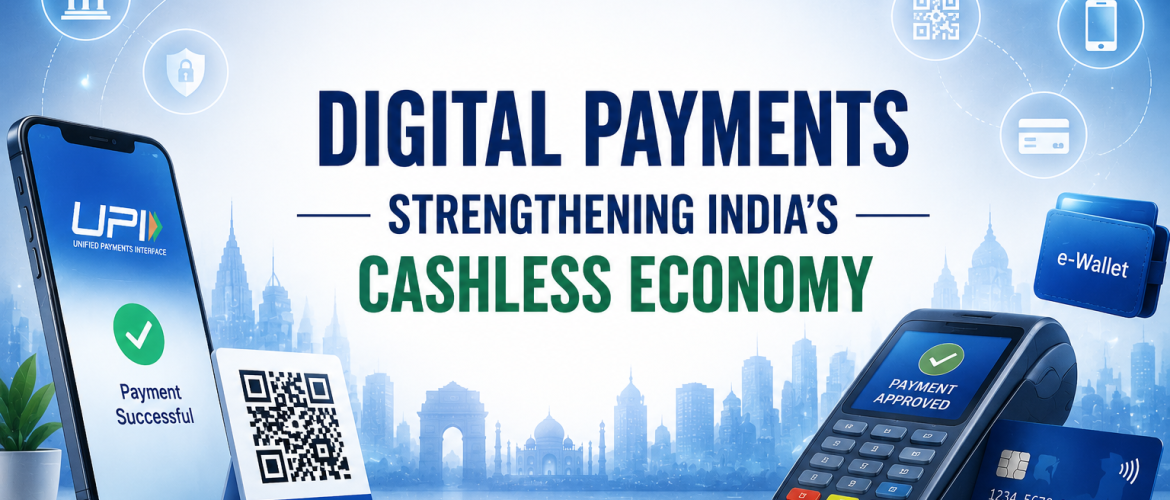
India has emerged as one of the world’s leading digital payment economies, driven by rapid technological innovation, supportive government policies, and widespread smartphone adoption. Over the past decade, the country has witnessed a remarkable transformation in the way financial transactions are conducted. What once required cash, lengthy banking procedures, or physical visits to financial institutions can now be completed within seconds using a smartphone.
Digital payment platforms such as the Unified Payments Interface (UPI), mobile banking, internet banking, QR code-based payments, digital wallets, debit and credit cards, and contactless payment systems have revolutionized financial transactions for individuals, businesses, and government agencies. This digital revolution has not only made payments more convenient but has also strengthened financial inclusion, improved transparency, and accelerated India’s transition toward a cashless economy.
Understanding Digital Payments
Digital payments refer to financial transactions conducted electronically without the use of physical cash. These transactions are processed through banks, payment service providers, and authorized digital platforms using secure online networks.
Today, Indians use digital payments for a wide range of activities, including:
- Shopping at retail stores and supermarkets
- Paying electricity, water, and gas bills
- Mobile and DTH recharges
- Online shopping and e-commerce
- Booking railway, airline, and bus tickets
- Paying school and college fees
- Hospital and medical payments
- Restaurant and hotel bills
- Government services and taxes
- Peer-to-peer money transfers
The ease of making payments anytime and anywhere has made digital transactions an integral part of everyday life.
UPI: The Backbone of India’s Digital Payment Revolution
One of the most significant contributors to India’s digital payment success is the Unified Payments Interface (UPI). Developed by the National Payments Corporation of India (NPCI), UPI enables users to instantly transfer money between bank accounts using a mobile number, QR code, or UPI ID.
Unlike traditional banking systems that often required account details and lengthy processing times, UPI offers real-time fund transfers 24 hours a day, seven days a week.
Key advantages of UPI include:
- Instant money transfers.
- Secure bank-to-bank transactions.
- Round-the-clock availability.
- Easy QR code payments.
- Minimal or zero transaction charges for most users.
- Support for multiple bank accounts through a single application.
UPI has become one of the largest real-time payment systems in the world and continues to witness rapid growth in transaction volumes every year.
Benefits for Consumers
Digital payments have significantly improved convenience for consumers. People no longer need to carry large amounts of cash or worry about finding exact change while making purchases.
Some major benefits include:
- Fast and hassle-free payments.
- Secure digital transaction records.
- Easy tracking of expenses.
- Immediate fund transfers to friends and family.
- Reduced risk of cash theft or loss.
- Convenient online shopping experiences.
Whether purchasing groceries, paying utility bills, or transferring money to relatives, digital payment systems provide speed and efficiency unmatched by traditional payment methods.
Empowering Small Businesses and Merchants
One of the most visible impacts of India’s digital payment revolution has been the empowerment of small businesses. From neighborhood grocery stores to roadside vendors and local service providers, merchants across the country have adopted QR code-based payment systems.
Digital payments have helped businesses by:
- Reducing dependence on cash handling.
- Increasing customer convenience.
- Maintaining accurate transaction records.
- Improving financial credibility.
- Simplifying business accounting.
- Enhancing access to formal banking and credit.
Banks and financial institutions can now evaluate digital transaction histories while offering loans to small entrepreneurs, helping them expand their businesses more easily.
Financial Inclusion and Economic Growth
Digital payments have played a crucial role in promoting financial inclusion by bringing millions of people into the formal banking system. Government initiatives such as the Pradhan Mantri Jan Dhan Yojana (PMJDY), Aadhaar integration, and mobile connectivity have enabled individuals in rural and remote areas to access digital financial services.
Direct Benefit Transfer (DBT) schemes now allow government subsidies, pensions, scholarships, and welfare payments to be transferred directly into beneficiaries’ bank accounts, reducing delays and minimizing leakages.
Greater financial inclusion has contributed to:
- Increased banking access.
- Better savings habits.
- Improved credit availability.
- Enhanced economic participation.
- Greater financial security for low-income households.
Government Initiatives Supporting Digital Payments
The Government of India has introduced several initiatives to promote digital financial services and encourage cashless transactions.
Major initiatives include:
- Digital India Mission.
- Unified Payments Interface (UPI).
- BHIM (Bharat Interface for Money) App.
- Aadhaar Enabled Payment System (AEPS).
- Direct Benefit Transfer (DBT).
- FASTag for electronic toll collection.
- Digital Banking Units.
- Promotion of QR code payments.
These initiatives have strengthened India’s digital infrastructure while encouraging both businesses and consumers to adopt electronic payment methods.
Growth of E-Commerce and FinTech
India’s booming e-commerce sector has further accelerated the adoption of digital payments. Online marketplaces, food delivery services, ride-sharing platforms, education technology companies, healthcare providers, and entertainment streaming services all rely heavily on digital payment systems.
At the same time, India’s FinTech industry has developed innovative financial solutions including:
- Digital lending platforms.
- Investment applications.
- Personal finance management tools.
- Buy Now, Pay Later (BNPL) services.
- Insurance technology platforms.
- Digital wealth management services.
The combination of FinTech innovation and digital payment infrastructure has made India one of the fastest-growing digital economies globally.
Enhancing Transparency in the Economy
One of the major advantages of digital payments is increased financial transparency. Electronic transactions create verifiable records, making financial activities easier to monitor and audit.
This has helped:
- Reduce cash-based transactions.
- Improve tax compliance.
- Minimize financial fraud.
- Strengthen anti-money laundering measures.
- Increase accountability in business operations.
Greater transparency also supports more effective economic planning and governance.
Cybersecurity: A Growing Priority
As digital payment usage continues to expand, cybersecurity has become increasingly important. Cybercriminals frequently attempt to exploit users through phishing emails, fake mobile applications, fraudulent phone calls, QR code scams, and identity theft.
Banks, payment service providers, and regulatory authorities regularly educate customers about safe digital practices.
Important cybersecurity measures include:
- Never sharing OTPs or banking passwords.
- Using strong and unique passwords.
- Enabling two-factor authentication (2FA).
- Downloading apps only from official app stores.
- Avoiding suspicious links and emails.
- Verifying QR codes before making payments.
- Monitoring bank account activity regularly.
- Updating mobile applications and operating systems.
Public awareness remains one of the strongest defenses against digital payment fraud.
Challenges Facing Digital Payments
Despite impressive progress, India’s digital payment ecosystem still faces several challenges.
These include:
- Uneven internet connectivity in rural areas.
- Digital literacy gaps among certain population groups.
- Cybersecurity threats and online fraud.
- Occasional technical outages.
- Dependence on smartphones and internet access.
- Limited digital awareness among elderly users.
Addressing these challenges will require continued investment in digital infrastructure, cybersecurity, financial education, and technology innovation.
Future of India’s Digital Payment Ecosystem
The future of digital payments in India looks extremely promising. Rapid deployment of 5G networks, increasing smartphone penetration, Artificial Intelligence (AI), blockchain technology, cloud computing, and advanced cybersecurity solutions are expected to make digital transactions even faster and more secure.
Emerging technologies such as voice-enabled payments, biometric authentication, wearable payment devices, and AI-powered fraud detection systems will further enhance customer experience.
As businesses, financial institutions, and government agencies continue investing in digital infrastructure, India is expected to remain a global leader in digital payment innovation.
Conclusion
Digital payments have fundamentally transformed India’s financial landscape by making transactions faster, safer, more transparent, and highly accessible. Technologies such as UPI, mobile banking, QR code payments, and digital wallets have empowered consumers, strengthened businesses, promoted financial inclusion, and supported economic growth. While challenges related to cybersecurity, digital literacy, and infrastructure remain, continuous technological advancements and supportive government initiatives are paving the way for a more inclusive and resilient digital economy. As India continues its journey toward becoming a digitally empowered nation, digital payments will remain a cornerstone of sustainable economic development and financial innovation.