
News
Western Ghats Update: Why India Is Taking Big Action Now
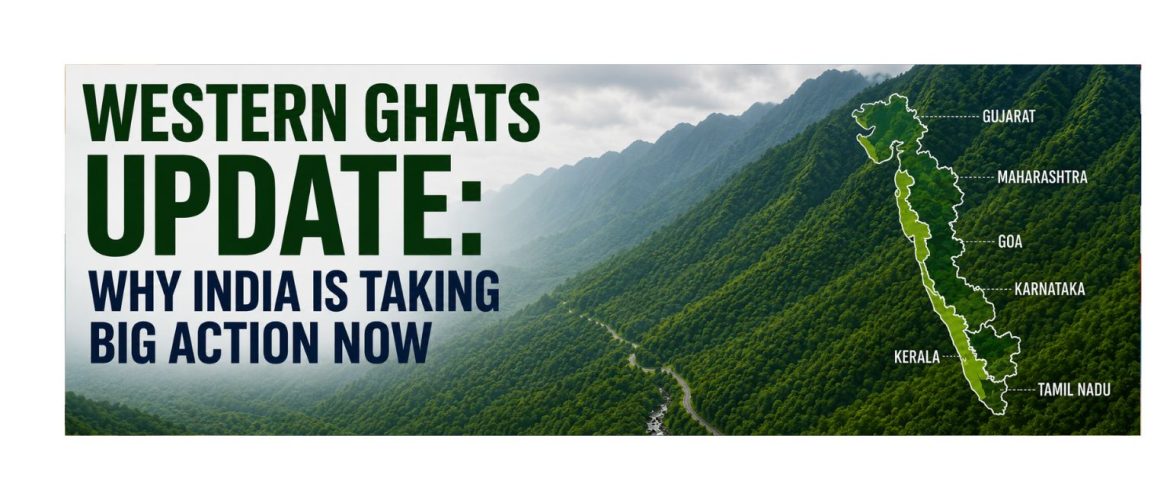
The Western Ghats, one of India’s most treasured natural landscapes, are once again at the center of a major environmental discussion. The Government of India has renewed its efforts to notify large portions of the Western Ghats as Eco-Sensitive Areas (ESA), a move aimed at protecting one of the world’s richest biodiversity hotspots from increasing environmental degradation. While conservationists have welcomed the decision as a long-overdue step toward safeguarding India’s ecological future, the proposal has also raised concerns among farmers, local communities, and state governments about its possible impact on livelihoods and development.
Stretching across six states and covering nearly 1,600 kilometres, the Western Ghats are far more than just a mountain range. They are the lifeline of peninsular India, giving birth to major rivers, supporting agriculture, regulating the monsoon, and providing habitat to thousands of rare and endemic species. However, decades of rapid urbanization, mining, deforestation, illegal quarrying, infrastructure projects, and climate change have pushed this fragile ecosystem under immense pressure.
The latest government action is not a sudden decision but the result of years of scientific research, committee recommendations, public consultations, and debates between environmental protection and economic development. Understanding why India is taking this significant step requires looking beyond the headlines to examine the ecological importance of the Western Ghats, the recommendations made by expert committees, the concerns of local communities, and the long-term implications for sustainable development.
In this article, we take a detailed look at the latest Western Ghats update, the reasons behind the government’s decision, and what it means for India’s environmental future.
What Is the Latest Western Ghats Update?
The Government of India has once again moved forward with its proposal to declare approximately 56,000 square kilometres of the Western Ghats as an Eco-Sensitive Area (ESA) under the Environment (Protection) Act. This proposal covers ecologically significant regions across Gujarat, Maharashtra, Goa, Karnataka, Kerala, and Tamil Nadu.
The primary objective of the notification is to regulate activities that could cause irreversible environmental damage while allowing sustainable development and protecting the livelihoods of local communities. The proposal mainly seeks to restrict environmentally harmful activities such as new mining operations, quarrying, highly polluting industries, and certain large infrastructure projects within the notified areas.
Before implementing the notification, the government has invited objections and suggestions from state governments and stakeholders. This consultation process reflects the government’s attempt to strike a balance between environmental conservation and regional development. Although the proposal has generated debates, it represents one of the country’s most significant conservation initiatives in recent years.
Why Is India Taking Big Action Now?
Growing Environmental Pressure
The decision comes at a time when environmental challenges across the Western Ghats have become increasingly severe. Rapid development has resulted in large-scale deforestation, habitat fragmentation, unregulated mining, expanding urban settlements, and the construction of highways and commercial projects in ecologically fragile regions.
Scientists have repeatedly warned that these activities are weakening the natural resilience of the Western Ghats. Forest loss not only threatens wildlife but also affects rainfall patterns, groundwater recharge, soil stability, and river systems that millions of people depend upon.
Climate change has further intensified these concerns. In recent years, several parts of Kerala, Karnataka, and Maharashtra have witnessed devastating floods, landslides, and extreme rainfall events. Environmental experts believe that uncontrolled development in ecologically sensitive regions has increased the vulnerability of these areas to natural disasters.
The latest government initiative is therefore viewed as an attempt to reduce future environmental risks while ensuring that India’s natural heritage remains protected for future generations.
Understanding the Ecologically Sensitive Area (ESA) Proposal
What Is an Eco-Sensitive Area?
An Eco-Sensitive Area is a region identified for its exceptional ecological importance where certain developmental activities are regulated to minimize environmental damage. The purpose of declaring an ESA is not to stop development altogether but to ensure that economic activities take place in an environmentally responsible manner.
Under the proposed notification, activities such as agriculture, horticulture, plantations, existing settlements, educational institutions, and healthcare facilities are generally allowed to continue. The restrictions mainly apply to activities that have long-term ecological consequences, including new mining projects, quarrying, thermal power plants, and highly polluting industries.
The proposal emphasizes sustainable development rather than blanket restrictions. This distinction is important because many misconceptions surrounding the ESA notification have led people to believe that farming and everyday life will be prohibited, which is not the case.
Why Are the Western Ghats So Important?
A Global Biodiversity Treasure
The Western Ghats are internationally recognized as one of the world’s 36 biodiversity hotspots, making them one of the most biologically diverse regions on Earth. The forests support thousands of species of flowering plants, mammals, birds, reptiles, amphibians, insects, and freshwater fish.
A remarkable feature of the Western Ghats is its high level of endemism. Many species found here do not exist anywhere else in the world. Animals such as the Lion-tailed Macaque, Nilgiri Tahr, Malabar Civet, Nilgiri Langur, and several species of frogs and reptiles depend entirely on these forests for survival.
Protecting such biodiversity is essential not only for ecological balance but also for scientific research, medicine, agriculture, and climate resilience.
The Water Lifeline of Peninsular India
The Western Ghats are often called the “Water Tower of India” because they are the origin of many major rivers, including the Godavari, Krishna, Kaveri, Periyar, and Tungabhadra.
These rivers supply drinking water to millions of people, irrigate vast agricultural lands, support industries, and generate hydroelectric power. Any ecological damage to the forests directly affects water availability across southern and western India.
Maintaining healthy forests ensures continuous water flow, groundwater recharge, and reduced soil erosion, making conservation critical for long-term water security.
The Kasturirangan Committee: The Foundation of the Current Proposal
The current ESA proposal is largely based on the recommendations of the Kasturirangan Committee, officially known as the High-Level Working Group. The committee was established after concerns were raised regarding earlier recommendations made by the Gadgil Committee.
Unlike the Gadgil Committee, which proposed extensive protection covering a larger area of the Western Ghats, the Kasturirangan Committee adopted a more balanced approach. It recommended protecting only the most ecologically valuable landscapes while allowing development in areas already influenced by human settlements.
The committee suggested restricting activities such as mining, quarrying, and highly polluting industries in identified Eco-Sensitive Areas while permitting agriculture, plantations, and sustainable livelihoods to continue.
The government’s present proposal largely follows this framework in an attempt to balance conservation with economic development.
Gadgil Committee vs. Kasturirangan Committee
Although both committees were formed to protect the Western Ghats, their recommendations differed significantly.
The Gadgil Committee proposed stronger environmental protection across a much larger portion of the Western Ghats. It recommended stricter controls on development activities and emphasized decentralized decision-making involving local communities.
The Kasturirangan Committee, on the other hand, recommended protecting a smaller area while allowing more flexibility for development. It focused on satellite mapping, scientific assessment, and identifying only the most ecologically sensitive landscapes for regulation.
Because the Kasturirangan recommendations were considered more practical, they became the basis for subsequent government proposals.
Why Are Some States Opposing the Proposal?
Despite its environmental objectives, the ESA notification has faced resistance from several state governments and local communities.
Many farmers worry that once their villages are included within Eco-Sensitive Areas, future construction, infrastructure projects, and economic opportunities may become restricted. Plantation owners have also expressed concerns regarding land-use regulations and possible administrative hurdles.
State governments argue that blanket restrictions may slow economic development and affect employment in regions dependent on mining, construction, and tourism.
Environmental groups, however, argue that these concerns can be addressed through proper implementation and public consultation, without compromising ecological protection.
The debate essentially revolves around finding the right balance between development and conservation.
What Happens Next?
The government is currently reviewing feedback from state governments, experts, and citizens before issuing the final notification.
Once finalized, implementation will require cooperation between the central government, state governments, forest departments, scientific institutions, and local communities.
Monitoring environmental compliance, preventing illegal mining, restoring degraded forests, and promoting sustainable livelihoods will be essential for the success of the initiative.
The final outcome will determine how India balances ecological conservation with developmental aspirations in one of its most environmentally significant regions.
Frequently Asked Questions (FAQs)
Why are the Western Ghats important?
The Western Ghats are one of the world’s richest biodiversity hotspots. They regulate the monsoon, provide water to millions of people, support agriculture, and serve as the habitat for thousands of endemic plant and animal species.
Why is the government declaring Eco-Sensitive Areas?
The proposal aims to protect ecologically fragile landscapes from activities such as mining, quarrying, and highly polluting industries while promoting sustainable development.
Will farming be banned in the Western Ghats?
No. The proposal does not prohibit agriculture, plantations, or existing settlements. It mainly regulates environmentally harmful activities.
Which states are covered under the proposal?
The proposal covers parts of Gujarat, Maharashtra, Goa, Karnataka, Kerala, and Tamil Nadu.
Why is the proposal controversial?
Some local communities and state governments fear restrictions on future development and land use, while environmentalists believe stronger conservation measures are necessary to protect the region.